
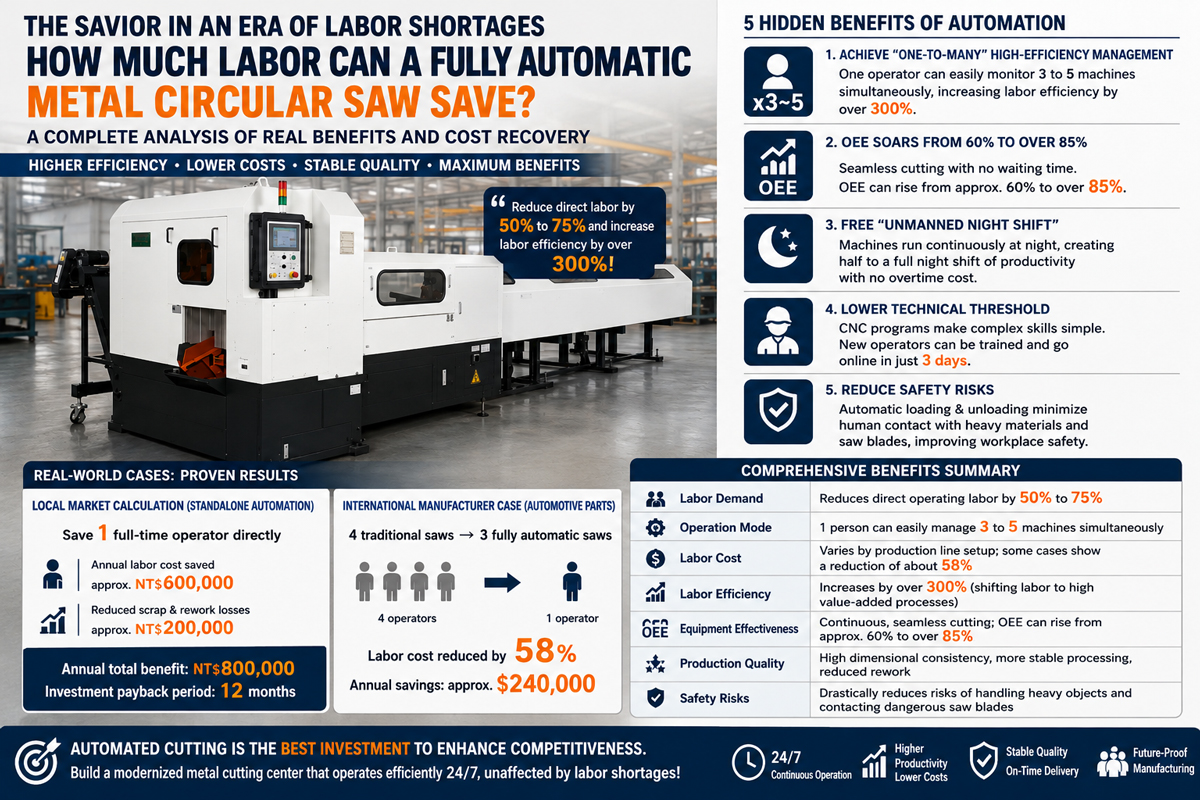
Facing severe labor shortages, continuously rising base salaries, and tight delivery pressures for urgent orders, the core question most bosses and factory managers care about is: "If I spend money upgrading to automated equipment, how much labor and cost can it actually save me?"
Based on real-world cases from multiple metal cutting equipment manufacturers and automated production research, fully automatic circular saws can generally reduce direct operating labor by 50% to 75%. In some highly automated production lines, the per-capita labor output can even increase by over 300%! This article will comprehensively analyze the actual benefits and ROI of introducing a fully automatic metal circular saw.
I. Why Do Traditional Circular Saws Require So Much Labor? (Pain Point Analysis)
Traditional semi-automatic or manual circular saws practically "tie" employees to the machines. A single operator must constantly repeat the following actions every day:
- Moving raw materials and positioning them for feeding
- Setting the cutting length and starting the cut
- Collecting materials, sorting finished products, and clearing scrap ends
- Continuously replenishing materials
Cutting thousands of pieces a day not only incurs massive labor costs but also leads to operator fatigue, increased dimensional errors, heightened safety risks, and invisible losses like the skills gap left by retiring experienced masters.
II. Real Data Breakdown: Direct Cost Savings from Automation
We use real cases from both domestic and international markets to calculate the astounding benefits brought by automation:
- Local Market Calculation: Upgrading traditional equipment to a "standalone automated" machine with automatic feeding usually eliminates the need for 1 full-time operator. Calculated using the average salary in Taiwan's manufacturing industry, this saves about USD $20,000 in personnel costs annually. Coupled with the reduction in scrap and rework losses (about USD $6,500) due to stable machine cutting (tolerance controlled at ±0.1mm), it can generate a direct annual benefit of USD $26,000, meaning the investment payback period is only about 12 months.
- International Manufacturer Case: An automotive parts supplier replaced 4 traditional cold saws (requiring 4 operators, one per machine) with 3 fully automatic cold saws. While maintaining a daily production capacity of about 12,000 pieces, they now only need 1 operator to patrol the machines, drastically reducing labor costs by 58% and saving about $240,000 in annual labor expenses.
III. Breaking the "One Person, One Machine" Curse: 5 Hidden Benefits of Automation
Fully automatic metal circular saws typically integrate features such as automatic loading (Bundle Loader), automatic feeding, CNC/servo positioning, automatic clamping, automatic cutting, unloading, and material sorting. This fundamentally changes the factory's operational model, creating hidden value that goes beyond mere headcount reductions:
1. Achieving "One-to-Many" High-Efficiency Management
The operator simply uses an overhead crane to place a whole bundle of metal onto the loading rack and selects the processing program; the machine then automatically completes the subsequent actions. Originally, 1 employee could only tend to 1 machine; now, 1 employee can easily monitor 3 to 5 circular saws simultaneously, directly increasing labor efficiency by over 300%.
2. Equipment Effectiveness (OEE) Surges from 60% to Over 85%
Many factories mistakenly believe "Automation = Hiring fewer people," but the greater value is actually "keeping the equipment continuously processing, rather than waiting for the operator." Traditional workflows require waiting for manual collection, feeding, and positioning after a cut; automated equipment, however, can immediately feed the material for the next cut after automatic unloading, significantly boosting Overall Equipment Effectiveness (OEE).
3. A Free "Unmanned Night Shift"
When dealing with urgent orders or continuous mass production, as long as the loading rack is filled before getting off work, the machine can continue running for hours at night. This is equivalent to gaining half or a full night shift of labor out of thin air, without paying overtime or night shift allowances, realizing the prototype of a "lights-out factory."
4. Drastically Lowering the "Technical Threshold", No Fear of Masters Retiring
Traditional sawing machines rely heavily on experienced masters to adjust the feed rate based on the sound and appearance of iron chips. CNC circular saws have built-in program memory and parameters, allowing them to directly call up the optimal cutting conditions, transforming a technical job requiring 3 years of experience into a standardized operation where a newcomer can go online after 3 days of training.
5. Reducing Potential Safety Risks
Manually handling long, heavy materials and repeatedly getting close to the saw blade can easily cause musculoskeletal injuries or hand crushing. Automatic loading and unloading systems reduce the chances of personnel coming into contact with hazardous areas, vastly improving operational safety.
IV. Suitable Industries for Automated Circular Saws and Comprehensive Benefits Summary
If your factory belongs to the following fields and requires long-term, high-volume cutting of bars, tubes, or profiles, the investment benefits of automation will be the most obvious: Automotive and motorcycle parts, bicycle parts, fitness equipment, hydraulic parts (pneumatic cylinders), fastener and screw industries, bearing manufacturing, aerospace parts, architectural hardware, and various stainless steel, aluminum, and copper material processing industries.
| Improvement Item | Common Benefits of Introducing Automated Circular Saws |
|---|---|
| Labor Demand | Reduces direct operating labor by approximately 50% to 75% |
| Operation Mode | 1 person can easily manage 3 to 5 machines simultaneously |
| Labor Cost | Varies by production line setup; some cases show a reduction of about 58% |
| Labor Efficiency | Increases by over 300% (shifting labor to high value-added processes) |
| Equipment Effectiveness | Continuous, seamless cutting; OEE can rise from approx. 60% to over 85% |
| Production Quality | High dimensional consistency (highly stable tolerance), more stable processing, reduced rework |
| Safety Risks | Drastically reduces the risks of personnel handling heavy objects and contacting dangerous saw blades |
Conclusion: Automated Cutting is the Best Investment to Enhance Competitiveness
For metal processing enterprises facing labor shortages and rising labor costs, the value of automated circular saws has long surpassed simply "saving money." By increasing equipment utilization, stabilizing processing quality, and shortening delivery times, it builds a more competitive, modernized smart manufacturing process for the enterprise. Instead of worrying about not being able to recruit people every month, let equipment replace labor and build a modernized metal cutting center that operates efficiently 24 hours a day, unaffected by labor shortages!