
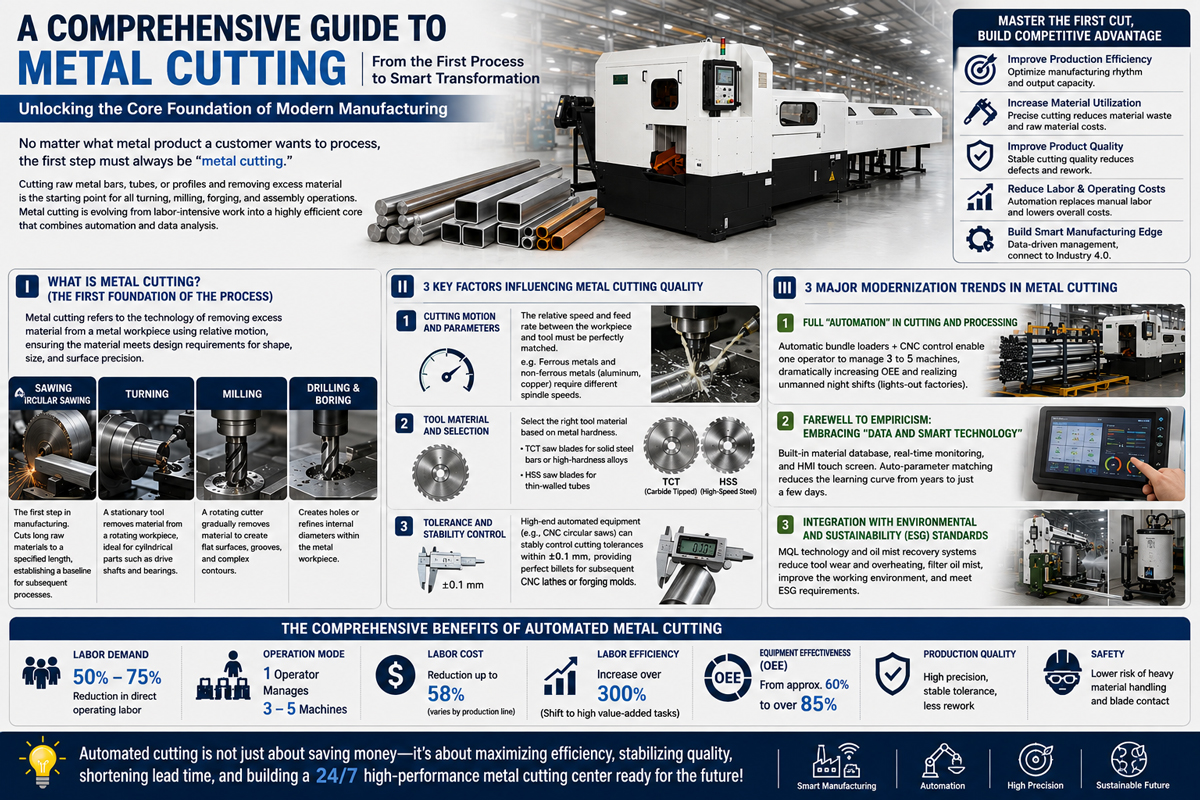
Metal cutting is the first step in every metal fabrication process. Whatever a customer needs machined — precision aerospace components, automotive drive shafts, or everyday metal furniture — the very first operation is always metal cutting: trimming raw metal bars, tubes, or profiles and removing excess material. It is the starting point for every turning, milling, forging, and assembly operation that follows.
As global manufacturing faces labor shortages and a push toward smart automation, metal cutting is rapidly evolving from a labor-intensive craft that relies on "veteran machinist experience" into a data-driven, highly automated core process. This article breaks down what metal cutting involves, its common methods, and the latest industry trends.
1. What Is Metal Cutting?
Definition: Metal cutting is the process of removing excess material from a metal workpiece — or cutting it to a fixed length — through relative motion between the tool and the material, producing the shape, dimensions, and surface finish required by the design.
Common metal cutting methods include:
- Sawing (Circular Sawing): The very first stage of the process, using a circular metal saw to quickly cut long raw stock to fixed lengths, setting the precision baseline for all downstream operations.
- Turning: A fixed cutting tool removes material from a rotating cylindrical or rod-shaped workpiece — ideal for drive shafts, bearing steel, and other round, symmetrical parts.
- Milling: A rotating milling cutter progressively removes material from a stationary or moving workpiece, used for flat surfaces, grooves, and complex contours.
- Drilling and Boring: Creates holes in a metal workpiece or refines an existing bore's internal diameter.
2. Three Key Factors That Determine Metal Cutting Quality
During cutting, metal is subjected to intense pressure from the tool, generating deformation, friction, and heat. Maintaining cutting quality and extending equipment life depends on three factors:
- Cutting Motion and Parameters: The relative speed and feed rate between the workpiece and the tool must be precisely matched. Ferrous metals and non-ferrous metals (such as aluminum and copper) require very different cutting speeds.
- Tool Material and Selection: Different metal hardness levels call for different tools. TCT (tungsten carbide-tipped) blades are commonly used for solid steel bars or high-hardness alloys, while HSS (high-speed steel) blades are typically paired with thin-walled tubing.
- Tolerance and Stability Control: Modern high-end automated cutting equipment — such as fully automatic CNC circular saws — can consistently hold cutting tolerances within ±0.1 mm, delivering zero-error blanks for downstream CNC lathes or forging dies.
3. Three Modern Trends Transforming Metal Cutting
Facing global supply chain volatility and labor shortages, the metal cutting industry is undergoing a major technological shift:
- Automation of Loading and Cutting
Modern factories increasingly deploy fully automated cutting systems that combine automatic bundle loaders with CNC control. This enables one operator to manage 3 to 5 machines simultaneously. Automated unloading and continuous cycling significantly increase Overall Equipment Effectiveness (OEE), and in some cases even support unmanned "lights-out" night shifts. - From Experience-Based Craft to Data-Driven Intelligence
Traditional cutting relied heavily on a veteran machinist's ability to judge feed speed by "listening to the sound and watching the chips." Modern intelligent cutting equipment now includes built-in material databases and real-time monitoring systems. Operators simply enter the metal type and dimensions on a touchscreen HMI, and the system automatically matches the optimal cutting parameters — shrinking a skill that once took years to master down to a learning curve of just a few days for new operators. - Integrating Environmental and Sustainability (ESG) Standards
As international environmental standards tighten, modern metal cutting facilities are placing greater emphasis on workplace conditions — for example, adopting Minimum Quantity Lubrication (MQL) technology or oil-mist recovery systems. These effectively prevent metal chips from sticking and tools from overheating, while filtering fine oil mist to reduce facility pollution.
Frequently Asked Questions
Q1: What are the common metal cutting methods?
The main methods are sawing, turning, milling, and drilling/boring. Sawing is typically the first stage, cutting stock to fixed lengths; turning suits round, symmetrical parts; milling handles flat surfaces, grooves, and complex contours.
Q2: What tolerance can a CNC automatic circular saw achieve?
High-end CNC fully automatic circular saws can consistently hold cutting tolerances within ±0.1 mm.
Q3: What's the difference between TCT and HSS saw blades?
TCT (tungsten carbide-tipped) blades are best suited for solid steel bars and high-hardness alloys, while HSS (high-speed steel) blades are commonly used for thin-walled tubing. The choice depends on the workpiece's material hardness and wall thickness.
Q4: What benefits does automated cutting bring to a factory?
It allows one operator to manage 3 to 5 machines at once, and automated unloading with continuous cycling significantly raises Overall Equipment Effectiveness (OEE) — in some cases enabling unmanned night-shift production.
Q5: How do smart cutting systems lower the skill barrier for new operators?
Built-in material databases and real-time monitoring let operators simply input the metal type and dimensions on a touchscreen, and the system automatically selects optimal cutting parameters — cutting the training time from years down to just a few days.
Conclusion: Mastering the First Cut Builds Manufacturing Competitiveness
Metal cutting is not just the first step in manufacturing — it's the critical factor that determines downstream production efficiency, material utilization, and finished product yield. Whether upgrading to automated circular saws to address labor shortages and reduce labor costs, or using precise tolerance control to minimize waste of costly raw materials, companies that continuously optimize this first cutting stage are the ones best positioned to compete on both quality and efficiency in modern smart manufacturing.
Further reading
Which Industries Are Metal Circular Saws Suitable For? A Complete Guide to Key Applications