
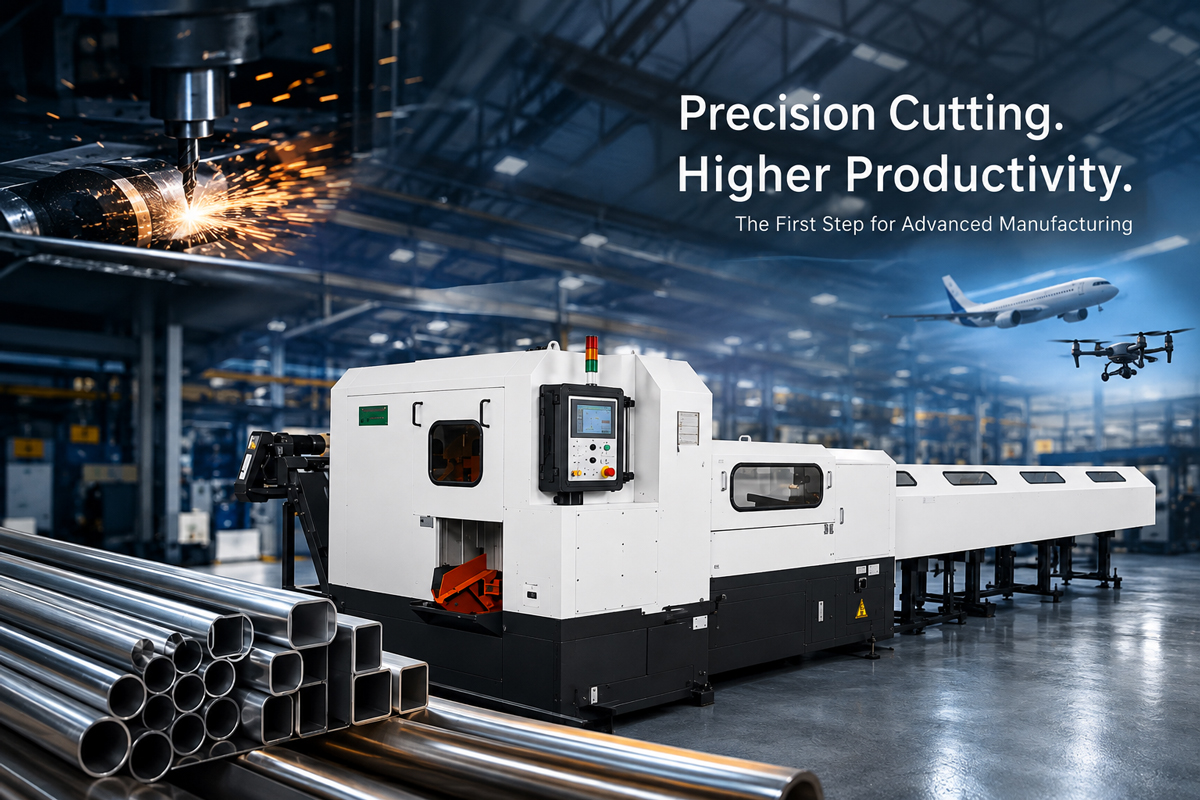
Do Aerospace and Drone Components Really Need Circular Saws? From Aluminum Alloy to Chromium and Inconel — How High-Rigidity Circular Saws Cut Machining Costs (Part 2)
This is Part 2 of a two-part series. Part 1 covers the technical challenges of sawing aerospace materials, international aerospace cases, and Kentai's actual track record machining Chromium and Inconel for Italian customers.
Summary (TL;DR)
- A real case from UK aerospace materials supplier Gould Alloys shows the same bar-cutting job taking under 10 seconds with a circular saw versus roughly 7–8 minutes with a band saw.
- Circular saws offer higher cutting precision, saving roughly 1 mm of material per cut — a meaningful cost difference for high-value aerospace materials.
- Drone-industry aluminum structural parts (fuselage, arms, landing gear, etc.) similarly rely on non-ferrous circular saws as the pre-CNC sizing step.
- Data from Japan's Saitama aerospace supply chain shows a single company's equipment list including 11 automatic circular saws — proof that circular saws operate at production-scale, not as auxiliary equipment, within the aerospace supply chain.
- Six cost-benefit categories of circular saws: labor cost, cutting time, material cost, blade/equipment usage cost, post-processing cost, and handling/waiting cost.
7. Are Circular Saws Really Faster Than Traditional Sawing? Real Data from an Aerospace Materials Supplier
Beyond aircraft-parts manufacturing, a real case from UK aerospace materials supplier Gould Alloys further illustrates how high-speed circular saws affect cost.
Gould Alloys has long supplied metal materials for aerospace and high-performance industries, including aluminum, alloy steel, stainless steel, nickel alloys, titanium, and phosphor bronze. The company had extensive experience with band saws before introducing circular saws for part of its cutting operations.
For bar/billet cutting at diameters around 100 mm or below:
- Cutting Method Time Required
- Circular saw Under 10 seconds
- Band saw Roughly 7–8 minutes
This isn't simply "faster." When large volumes of material need cutting daily, this time gap directly translates into:
- Higher daily throughput
- Lower per-part processing time
- Reduced operator waiting time
- Higher equipment utilization
- Shorter lead times
- The ability to take on short-lead-time orders
More importantly, the case notes that circular saws in this application also deliver higher cutting precision, saving roughly 1 mm of material per cut.
For high-value aerospace materials, that 1 mm is not a small number.
8. The More Expensive the Aerospace Material, the More Every Cut Counts
With ordinary carbon steel, some material waste may be acceptable. Aerospace materials are a different story — for example:
- High-strength aluminum alloys
- Titanium alloys
- Inconel
- Hastelloy
- Chromium
- Aerospace-grade bars and profiles
These materials inherently carry high value. As a result, kerf loss, remnants, cutting error, and defective parts can all become direct costs.
Italy's Friggi aerospace cutting equipment cases also show that cutting aluminum, titanium, Inconel, and Hastelloy for aerospace use is designed not only around cutting capability, but also around reducing operator time and material-handling cost.
For high-value materials, material utilization is itself productivity.
9. The Drone Industry: Non-Ferrous Circular Saws Are Also a Key Front-End Process
While the drone industry doesn't use as many complex metal components as large commercial aircraft, medium-to-large industrial drones, military drones, and high-performance UAVs still require substantial lightweight metal structures.
Aluminum alloys — lightweight, high-strength, and easy to machine — are commonly used for:
- Fuselage structure
- Brackets
- Arms
- Motor mounts
- Landing gear structure
- Connectors
- Structural components
Before entering CNC milling, drilling, or other precision machining, long aluminum bars, rods, or profiles typically need to be cut to size first. A typical workflow looks like this:
Aluminum bar/profile → KTC-NF non-ferrous automatic circular saw → sized cutting → CNC milling/drilling → surface treatment → drone structural part
In this workflow, the circular saw isn't responsible for forming the final complex geometry — it converts long stock quickly and stably into blanks ready for downstream machining. That's why automatic non-ferrous circular saws hold real value in the drone and aerospace supply chain.
10. 7075 Aerospace Aluminum: The Technical Challenge of High-Speed Circular Sawing
7075 aluminum alloy is valued in aerospace for its high strength-to-weight ratio. But "aluminum is easy to machine" doesn't mean every sawing condition is the same.
A 2025 study published in the Journal of Manufacturing Processes specifically analyzed high-speed circular sawing of 7075 aerospace aluminum, examining cutting force, vibration, chip formation, and tool wear. The study found that, under its test conditions, increasing blade rotation speed reduced cutting force and improved surface quality. (Source: ScienceDirect)
This illustrates that efficient sawing of aerospace aluminum requires the machine, blade, rotation speed, feed rate, and material properties to work together in balance.
A circular saw truly suited to aerospace and drone manufacturing isn't simply about maximizing speed — it needs to find the right balance across speed × precision × tool life × surface quality × material utilization.
11. Japan's Aerospace Supply Chain: Automatic Circular Saws Aren't Rare, Specialized Equipment
Data from Saitama Prefecture's Aerospace Industry Cluster in Japan also shows the real presence of automatic circular saws in the aerospace supply chain.
One aerospace-related company's equipment list includes 11 automatic circular sawing machines, with cutting capacity spanning roughly 15–1500 mm in length and up to about Ø85 mm in material diameter. (Source: Saitama Aerospace Industry Cluster)
This data point is worth noting because it shows: within the aerospace supply chain, automatic circular saws can operate not as mere auxiliary equipment, but as formal production equipment deployed at real scale.
As product volumes grow, material types diversify, and lead times shrink, front-end sawing capacity begins to directly affect an entire factory's throughput.
12. What Circular Saws Really Save Factories: The Cost of the Whole Process
Looking only at equipment purchase price, a circular saw might seem like a capital expense. But for aerospace and drone parts manufacturers, what matters more is the actual machining cost per part, which can be broken down into six categories:
Cost Category How the Circular Saw Helps
① Labor cost Automatic feeding, clamping, cutting, and unloading reduce the need for continuous operator involvement
② Cutting time High-speed circular saws dramatically cut per-part cutting time (e.g., Gould Alloys: 7–8 minutes → under 10 seconds)
③ Material cost More precise cutting reduces material loss per cut (e.g., roughly 1 mm saved per cut)
④ Blade/equipment usage cost Sufficient machine rigidity reduces abnormal blade wear caused by vibration and deflection (see Kentai's Italian Chromium and Inconel cases)
⑤ Post-processing cost Low-burr, near-net-size parts reduce deburring and finishing work
⑥ Handling/waiting cost Automated sawing and material feeding reduce manual handling, repositioning, and equipment idle time
13. From "Can It Cut" to "Can It Cut Stably, Long-Term" — That's What Defines a True High-End Circular Saw
From international aerospace cases to Kentai's own customer experience, one common thread emerges:
What truly tests high-end materials isn't whether a machine can cut them — it's whether it can cut them stably.
Aerospace aluminum alloys demand speed and precision. Chromium demands high rigidity and cutting stability. Inconel demands that the machine, clamping, feed, and tooling all withstand heavy cutting loads together.
A circular saw truly suited for high-end metal machining therefore needs more than a high-speed spindle — it needs a complete mechanical structure and machining system. Machine rigidity is the foundation of all high-precision, high-load cutting.
Conclusion: Aerospace Manufacturing Demands Not Just Precision, but Cost-Per-Cut
Aerospace and drone metal machining requirements can often be summed up as: precise, fast, stable. But for manufacturers, what truly matters is adding one more condition behind those three: low cost.
A high-efficiency, high-rigidity automatic circular saw creates value in multiple ways:
- Cuts faster → reduces labor and equipment time
- Cuts more precisely → reduces material loss
- Cuts more cleanly → reduces post-processing
- Sufficient machine rigidity → improves stability when machining difficult materials
- Automated feeding → increases throughput and reduces labor dependency
From European aircraft fuel-line and turbine-related components, to aerospace aluminum bars and profiles, to Kentai's actual customer machining of Chromium and Inconel — they all point to the same conclusion:
The circular saw may not be the most visible piece of equipment in aerospace manufacturing, but it can be the critical first step that shapes the cost of the entire process.
For manufacturers doing front-end processing on aluminum alloys, Chromium, Titanium, Inconel, tubes, profiles, and bars, choosing a non-ferrous circular saw with sufficient rigidity, precision, and automation isn't just about faster cutting — it's a meaningful investment in material utilization, process stability, and overall manufacturing efficiency.
Cutting costs from the very first cut is what lets everything downstream — CNC machining and the entire manufacturing flow — run faster and more efficiently.
Frequently Asked Questions (FAQ)
Q1: How much faster is a circular saw than a band saw?
A: In Gould Alloys' real-world case, cutting bar stock around 100 mm in diameter or less took under 10 seconds with a circular saw, versus roughly 7–8 minutes with a band saw.
Q2: How much material can a circular saw save on aerospace parts?
A: According to real-world cases, higher-precision circular saw cutting saves roughly 1 mm of material per cut — a meaningful cost difference for high-value aerospace materials.
Q3: Why do drone parts also need non-ferrous circular saws?
A: Aluminum structural parts on drones — fuselage, arms, landing gear, and similar components — typically need to be cut to size with a non-ferrous circular saw before entering CNC milling or drilling, turning long stock into machining-ready blanks.
Q4: How widely are automatic circular saws used in the aerospace supply chain?
A: Data from Japan's Saitama aerospace supply chain shows a single company's equipment list including 11 automatic circular saws — indicating this equipment operates as formal production equipment, not as a minor auxiliary tool.
Q5: What are the main cost savings from adopting a high-rigidity circular saw?
A: Primarily six categories: labor cost, cutting time, material cost, blade/equipment usage cost, post-processing cost, and handling/waiting cost.
Further reading: Do Aerospace and Drone Components Really Need Circular Saws? From Aluminum Alloy to Chromium and Inconel — How High-Rigidity Circular Saws Cut Machining Costs (Part 1)