
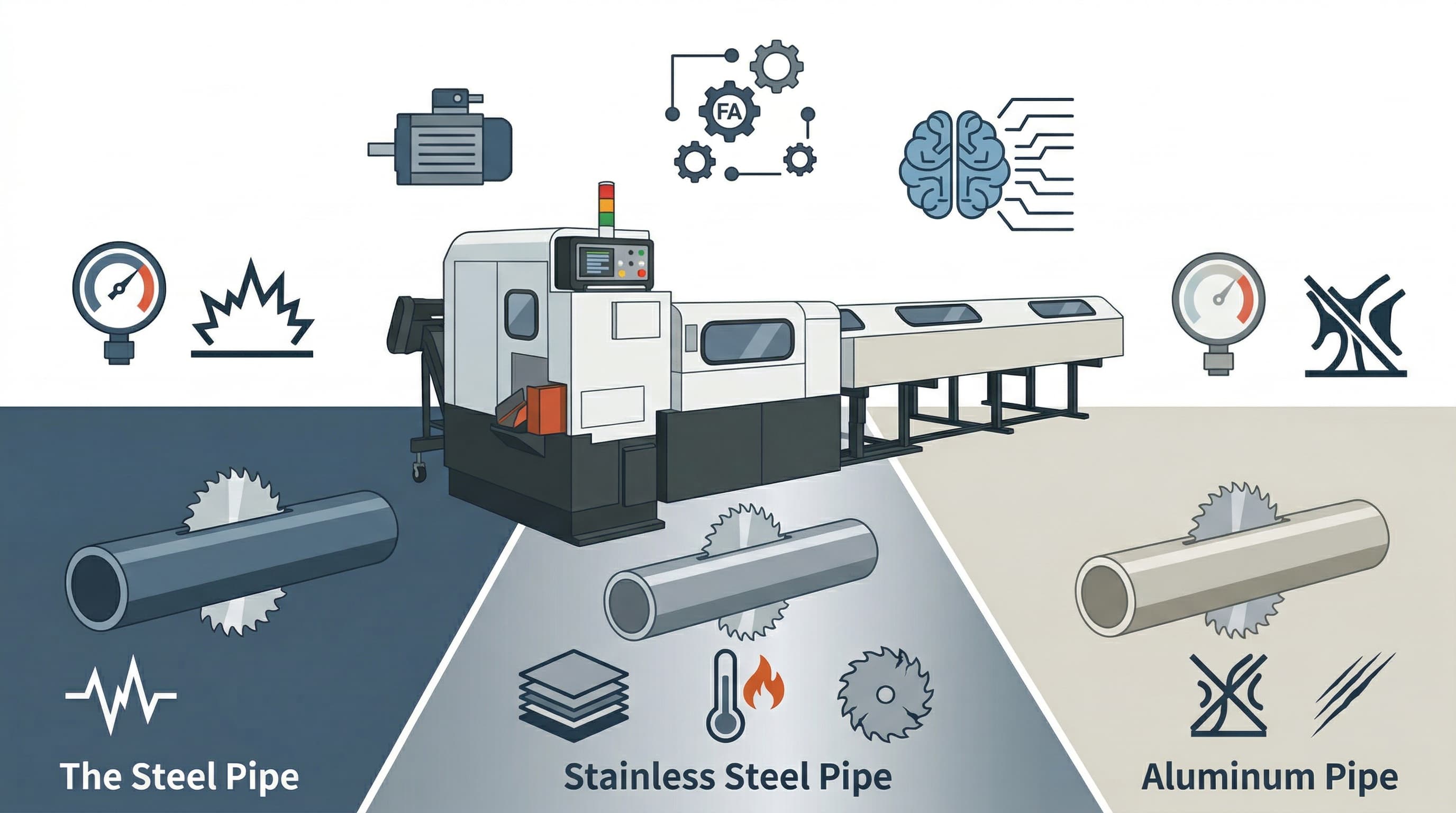
In the steel and tube processing industry, metal circular saws have become essential equipment for improving production efficiency and cutting quality. Whether cutting steel pipes, stainless steel pipes, or aluminum tubes, each material has distinct cutting characteristics. Without the right equipment and parameters, issues such as burrs, deformation, and rapid tool wear can easily occur.
From the perspective of a professional manufacturer, KENTAI Machinery will guide you through the cutting differences of various tube materials and explain how high-performance metal circular saws can achieve stable and precise cutting results.
The Role of Metal Circular Saws in Tube Cutting
Metal circular saws cut materials using a high-speed rotating saw blade. Compared with traditional band saws or manual cutting equipment, they offer the following advantages:
- Fast cutting speed, suitable for mass production
- Smooth cutting surface, reducing the need for secondary processing
- Compatible with automatic feeding systems to improve efficiency
- Stable precision, suitable for high-specification components
Especially in tube processing fields such as tube manufacturing, automotive and motorcycle parts, the bicycle industry, and architectural hardware, cutting quality and efficiency are highly required. As a result, CNC fully automatic metal circular saws have become a mainstream solution.
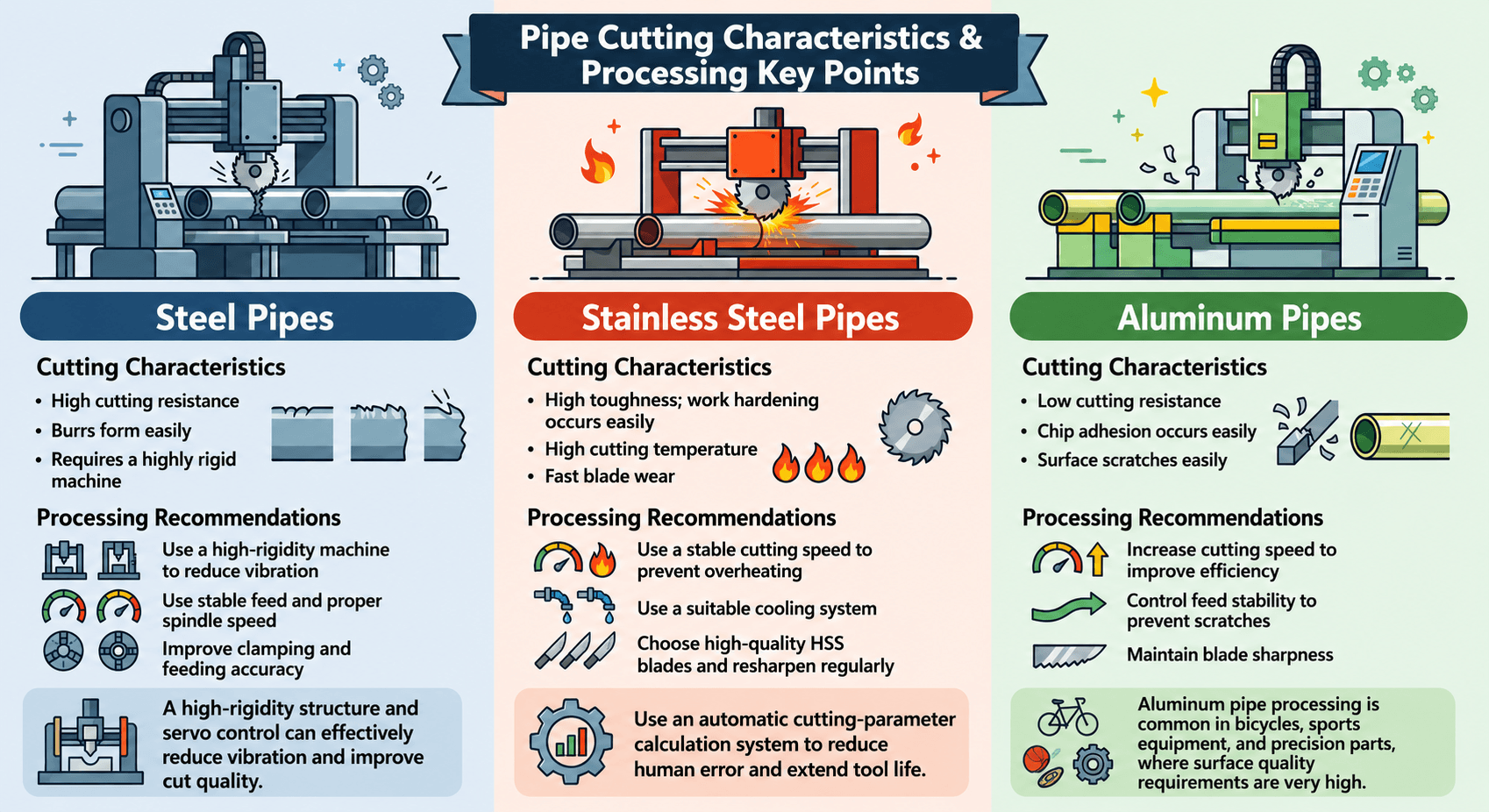
Cutting Characteristics and Processing Points of Steel Pipes
Steel pipes are materials with high strength and moderate hardness. During cutting, the following points should be considered:
Cutting Characteristics
- Higher cutting resistance
- Burrs are more likely to occur
- High machine rigidity is required
Processing Recommendations
- Use a high-rigidity machine to reduce vibration
- Apply stable feeding and appropriate rotational speed
- Strengthen clamping and feeding accuracy
With a high-rigidity structural design and servo control, vibration can be effectively reduced while improving the quality of the cut surface.
Challenges and Solutions for Cutting Stainless Steel Pipes
Due to its corrosion resistance and high toughness, stainless steel is more difficult to cut and is a common challenge for many processing plants.
Cutting Characteristics
- High toughness, prone to work hardening
- High cutting temperature
- Faster saw blade wear
Processing Recommendations
- Maintain a stable cutting speed to avoid overheating
- Use an appropriate cooling system
- Select high-quality HSS saw blades and resharpen them regularly
When paired with a system that automatically calculates optimal cutting parameters, human error can be effectively reduced and tool life can be extended.
Cutting Characteristics and Efficiency Advantages of Aluminum Tubes
Aluminum is lightweight and highly ductile, making it relatively easy to cut. However, quality control is still essential.
Cutting Characteristics
- Low cutting resistance
- Prone to blade clogging or material adhesion
- Surface scratches can occur easily
Processing Recommendations
- Increase cutting speed to improve efficiency
- Maintain stable feeding to prevent scratches
- Ensure the sharpness of the saw blade
Aluminum tube processing is commonly used in bicycles, sports equipment, and precision parts industries, where surface quality requirements are extremely high.
Comparison of Cutting Differences Among Three Tube Materials
| Material | Cutting Difficulty | Cutting Speed | Tool Wear | Processing Focus |
|---|---|---|---|---|
| Steel Pipe | Medium | Medium | Medium | Stable cutting and reduced vibration |
| Stainless Steel Pipe | High | Slow | High | Prevent overheating and work hardening |
| Aluminum Tube | Low | Fast | Low | Avoid material adhesion and scratches |
The Key to High-Efficiency Cutting: Equipment and Automation
To achieve stable and efficient tube cutting, the performance of the equipment itself is crucial. Taking KENTAI metal circular saws as an example, they feature several key designs that enhance productivity:
Fully Automatic Cutting System
- Supports 24-hour continuous operation
- Automatically calculates optimal cutting conditions
- Reduces dependence on manual labor and minimizes operating errors
High-Precision Servo Feeding
- Accurate fixed-length cutting
- The third-axis servo can reduce remnant material to 20 mm
- Improves material utilization
High-Rigidity Structural Design
- Made with FCD-45 ductile cast iron
- Improves wear resistance and vibration absorption
- Reduces cutting vibration and improves cut surface quality
Smart Manufacturing Integration
- Enables remote monitoring of machine status
- Can be integrated with robotic arms
- Suitable for automated production lines
In addition, with a bundle-type loading rack design, full bundles of materials can be automatically fed, greatly improving production capacity and efficiency.
Why Choose a High-Speed Metal Circular Saw?
For companies requiring mass production and high-precision cutting, high-speed metal circular saws offer the following advantages:
- Improved cutting efficiency and shorter production cycles
- Stable quality and lower defect rates
- Automated production with reduced labor costs
- Suitable for various materials and industrial applications
Since its establishment in 1985, KENTAI Machinery has focused on the research, development, and manufacturing of metal circular saws and HSS saw blade grinding machines. Its products are sold in more than 20 countries worldwide and have obtained CE and ISO 9001 certifications, providing efficient and reliable solutions for the steel industry, tube manufacturing industry, and various metal processing sectors.
Understanding Material Differences and Choosing the Right Equipment Are Key
Steel pipes, stainless steel pipes, and aluminum tubes each have different cutting characteristics. Only by understanding these material differences and combining them with high-performance metal circular saws and the correct processing parameters can manufacturers achieve high-efficiency and high-quality cutting results.
If you are looking for cutting equipment that delivers speed, precision, and automation, choosing a professional manufacturer with complete technical expertise and service support will be a key step toward improving your competitiveness.