
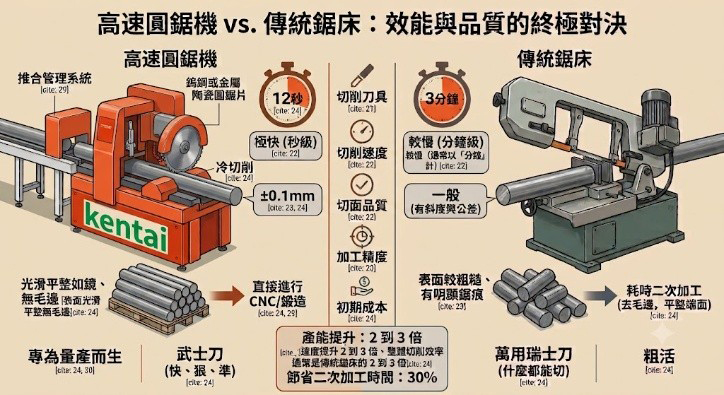
In the high-speed competition of metal processing, “time” is the most expensive cost. If your factory still relies on traditional band saw machines for high-volume cutting of standard parts, watching the machine slowly work back and forth, you may be losing significant production capacity and hidden profits.
This article will provide a straightforward analysis of the core differences between high-speed circular saw machines and traditional saw machines, as well as how dramatically your cutting efficiency can improve after upgrading your equipment.
Core Differences: Which Tool Does Your Factory Need?
To choose the right equipment, you must first understand their physical characteristics and strengths. We have simplified complex mechanical principles into the most intuitive comparison:
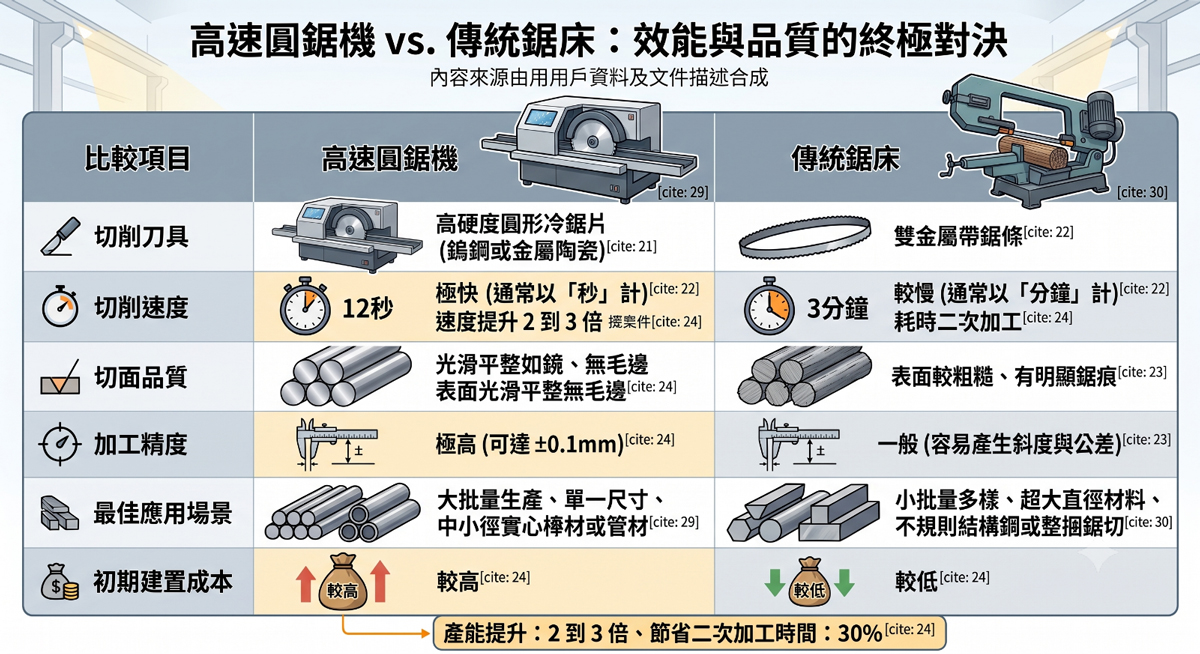
The straightforward conclusion: A traditional band saw machine is a versatile Swiss Army knife that can cut almost anything and is suitable for rough cutting of large-diameter materials. A high-speed circular saw machine, on the other hand, is a samurai sword designed specifically for mass production, focusing on speed, power, and precision.
How Much Can Efficiency Improve After Upgrading to a High-Speed Circular Saw Machine?
Upgrading to a high-speed circular saw machine is not simply replacing one machine. It reshapes the efficiency of the entire production line. The following are specific data and efficiency improvements:
- Rapidly Increased Production Capacity with 2 to 3 Times Higher Speed
Traditional saw machines are often limited by the pulling resistance of the saw blade. In contrast, a high-speed circular saw machine uses a highly rigid machine body and a saw blade rotating at thousands of revolutions per minute, allowing it to cut through a 50 mm medium-carbon steel bar in just over ten seconds. Overall cutting efficiency is typically 2 to 3 times higher than that of traditional saw machines, directly doubling your daily production capacity. - Maximum Precision with Tolerances Reduced to ±0.1 mm
Traditional band saw blades can easily deform under force during cutting, resulting in angled cutting surfaces. High-speed circular saw machines use highly rigid circular saw blades and servo feeding systems, allowing cutting tolerances to be strictly controlled at approximately ±0.1 mm, significantly improving material yield. - Eliminate “Hidden Costs” and Save 30% of Secondary Processing Time
Workpieces cut by traditional saw machines often have rough end surfaces and require additional lathe processing to flatten the ends or remove burrs. High-speed circular saw machines use “cold cutting,” which generates less cutting heat and produces smooth, deformation-free cutting surfaces. After cutting, the workpiece can almost directly proceed to the next CNC machining or forging process. This not only saves machine and labor costs for secondary processing but also significantly shortens delivery times.
Conclusion: It Is Time to Upgrade Your Cutting Process
If your orders involve high-volume production, high precision requirements, and mainly small- to medium-diameter metal bars and tubes, typically under 150 mm, continuing to use traditional saw machines means wasting valuable labor and time costs without realizing it.
Although the initial equipment and saw blade consumable costs of introducing a high-speed circular saw machine are higher, the advantages of “doubling production capacity” and “eliminating secondary processing” can usually generate a return on investment for the company within a very short period. Review your production line requirements now and let a high-speed circular saw machine become your secret weapon for staying ahead of the competition!