
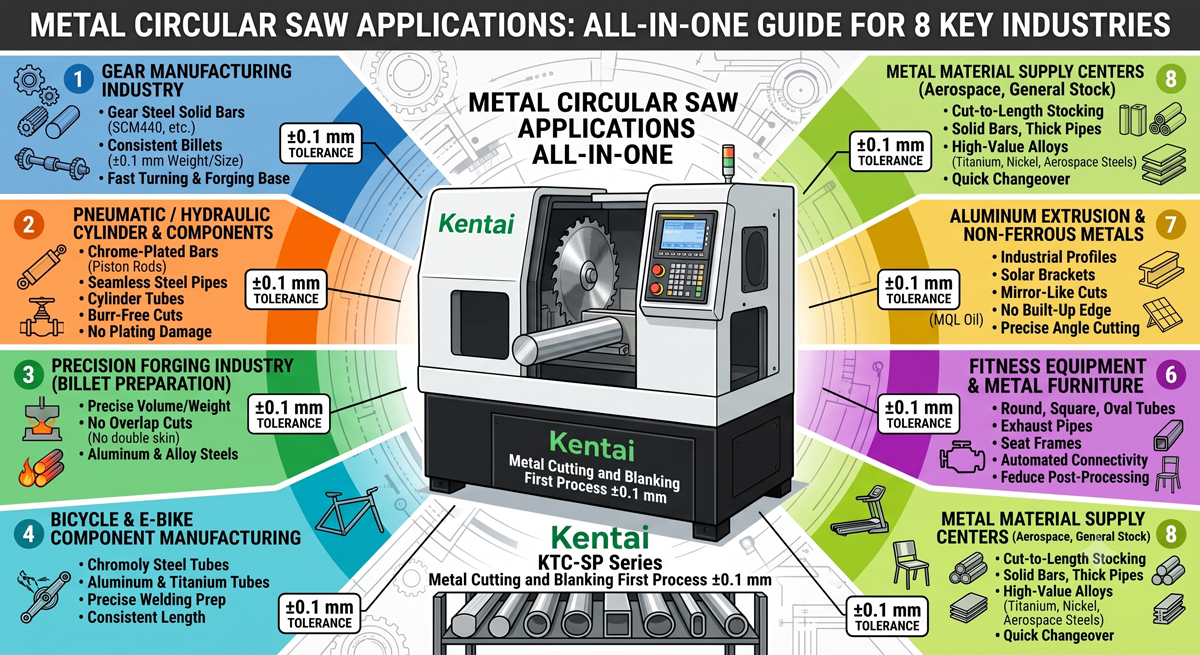
In the metalworking field, there is an unchanging golden rule: "No matter what metal product a customer wants to process, the first step must always be 'cutting to length'—cutting the raw material to the specified length before any subsequent processing can begin."
As the core equipment for this initial step, the Metal Circular Saw Machine has become the preferred cutting tool for many metal processing plants, forging factories, and parts manufacturers, thanks to its extremely fast cutting speed, excellent cross-sectional flatness, and stable tolerance control (up to ±0.1 mm).
Whether it is ferrous metals like black iron and stainless steel, or non-ferrous metals and special alloys like aluminum, copper, and titanium alloys, the metal circular saw machine can easily handle them. This article will comprehensively outline the core application industries and fields suitable for metal circular saw machines to help you accurately evaluate the benefits of introducing this equipment!
1. Why Choose a Circular Saw for the First Step of Metalworking?
The first step in metalworking is cutting the material to size. The quality of the cut directly determines the efficiency and quality of subsequent turning, milling, forging, welding, and assembly. Compared to traditional band saws or abrasive cutting, metal circular saw machines have the following core advantages:
- Stable High Precision: Cutting tolerance can be stably controlled at ±0.1 mm, providing a highly consistent baseline for subsequent processing.
- Extremely Fast Cutting Speed: The cutting efficiency is much higher than that of band saws, drastically reducing the time required for the first cutting step, making it highly suitable for mass production.
- Flat Cross-Sectional Quality: The cut is flat, with few burrs and no thermal distortion, significantly reducing the time required for secondary processing or end-face trimming.
- Raw Material Cost Savings: The small kerf loss maximizes material utilization, especially for high-value metal materials.
- Easy to Integrate with Automation: It can be easily integrated with automatic loading racks and robotic arms to achieve 24-hour unmanned, continuous cutting.
2. Which Industries Are Metal Circular Saws Suitable For? Core Application Areas
1. Petroleum, Energy, and Heavy Pipeline Industry (OCTG and Tubing)
Oil exploration, shale gas extraction, and energy transmission have extremely high requirements for pipe strength and cut quality:
- Applicable Materials: Oil Country Tubular Goods (OCTG), seamless steel pipes, high-strength thick-walled pipes, stainless steel pipelines.
- Application Scenarios: Cutting oil pipes to length and preparing pipe ends. It provides flat cuts with high perpendicularity, facilitating subsequent threading and butt welding.
2. Gear Manufacturing and Transmission System Industry
Before gear processing, solid bars must be cut into standard steel billets. Tolerance and cross-sectional perpendicularity are crucial:
- Applicable Materials: Gear steel bars (e.g., SCM440, 8620, and other alloy steels), solid round bars.
- Application Scenarios: High-efficiency cut-to-length operations, ensuring that the weight and size of each gear billet are consistent (±0.1 mm), avoiding excess flash or underfilling during subsequent forging or turning.
3. Precision Forging, Hot Forging, and Cold Forging Industry
Before entering the heating furnace or stamping press, forging industries must first perform precise cutting of "billets/slugs":
- Applicable Materials: Carbon steel solid bars, alloy steel bars, aluminum alloy forging billets.
- Application Scenarios: Precisely controlling the cutting volume and weight, producing a flat cut without overlap (double skin), preventing cracks or excessive mold wear during the forging process.
4. Pneumatic Cylinder, Hydraulic Cylinder, and Hydraulic Component Manufacturing
Pneumatic and hydraulic cylinders have extremely high tolerance and flatness requirements for the inner/outer diameter of the cylinder tube and the shaft length:
- Applicable Materials: Chrome-plated bars (pneumatic cylinder piston rods), seamless steel pipes, aluminum alloy cylinder tubes, stainless steel shafts.
- Application Scenarios: High-precision cutting of cylinder tubes and piston rods (±0.1 mm), ensuring the cut does not damage the plating and is burr-free, which facilitates subsequent assembly and the installation of seals.
5. Automotive, Bicycle, and E-Bike Components Industry
Both the automotive/motorcycle and bicycle industries require cutting large quantities of tubes and bars:
- Applicable Materials: Drive shafts, shock absorber tubes, exhaust pipes, chrome-molybdenum steel tubes, aluminum alloy frame tubes, titanium alloy tubes.
- Application Scenarios: 24-hour automated continuous cutting, ensuring consistent lengths for every tube, and reducing subsequent robotic welding and assembly errors.
6. Fitness Equipment and Metal Furniture Manufacturing
Treadmills, weight training equipment, and metal desks/chairs require mass production and a smooth appearance:
- Applicable Materials: Round tubes, square tubes, oval tubes, iron chair tubes, display rack profiles.
- Application Scenarios: Fast, high-volume cutting providing burr-free cuts, significantly reducing manual deburring and preparation time before welding.
7. Aluminum Extrusion and Non-Ferrous Metal Processing
Aluminum profiles and copper materials are relatively soft. High-speed cutting is required to prevent built-up edge (BUE):
- Applicable Materials: Industrial aluminum extrusions, solar mounting brackets, door and window aluminum profiles, copper bars, copper tubes.
- Application Scenarios: Paired with specialized saw blades and minimum quantity lubrication (MQL) to achieve mirror-like cuts and precise angle cutting (45°/90°).
8. Aerospace Precision Manufacturing and Metal Material Supply Centers
Material suppliers and high-end manufacturing industries face the daily need to cut various metal materials to length:
- Applicable Materials: Titanium alloys, nickel-based alloys, high-strength steels, solid steel bars, thick-walled tubes.
- Application Scenarios: High-precision cut-to-length of expensive raw materials, saving precious metal waste, and meeting the needs of both low-volume/high-mix and high-volume customers.
3. Metal Circular Saw Machine Industry Application Comparison Table
| Industry Category | Main Cutting Materials | Key Requirements & Features | Recommended Equipment Type |
|---|---|---|---|
| Petroleum & Energy Pipelines | OCTG, high-strength thick-walled steel pipes | High perpendicularity, flat cuts for threading | Heavy-Duty Tube Circular Saw Machine |
| Gear Manufacturing | Gear steel solid bars, alloy steel | Stable tolerance (±0.1 mm), consistent billet weight | Fully Automatic High-Speed Bar Circular Saw |
| Precision Forging | Steel bars, aluminum forging billets | Precise volume control, flat cut without overlap | CNC Automatic Billet Cutting Circular Saw |
| Pneumatic / Hydraulic Cylinders | Chrome-plated bars, cylinder tubes, aluminum tubes | Tolerance ±0.1 mm, does not damage plating | High-Precision Circular Saw for Cylinders |
| Automotive & Bicycle | Drive shafts, shock absorber tubes, chromoly tubes | High-speed mass cutting, automated connection | Fully Automatic CNC Metal Circular Saw |
| Fitness Equipment / Furniture | Round, square, and oval tubes | Fast cutting speed, burr-free cuts | Automatic Feeding Tube Circular Saw |
| Aluminum & Non-Ferrous | Aluminum extrusions, solar brackets, copper bars | Smooth cut without BUE, precise angles | High-Speed Circular Saw for Aluminum |
| Material Supply Centers | Solid round bars, thick-walled tubes, special alloys | Quick changeover, stable continuous cutting | Fully Automatic Universal Metal Circular Saw |
4. 3 Key Recommendations for Purchasing a Metal Circular Saw Machine
Professional Tip: Getting the first cutting process right ensures smooth downstream processing!
1. Differentiate Material Characteristics (Ferrous vs. Non-Ferrous Metals):
- Ferrous, Stainless Steel, and Alloy Steel: Require low-speed, high-torque metal circular saw machines, equipped with a cutting fluid cooling system to ensure tool life and tolerance.
- Aluminum, Copper, and Other Non-Ferrous Metals: Require high-speed equipment, paired with specific saw blades and micro-mist lubrication (MQL) to prevent metal chips from sticking.
2. Demand Stable Tolerance Control:
- The first cutting step directly affects the positioning for subsequent CNC lathes or forging molds. Choosing equipment that can stably maintain a tolerance range of ±0.1 mm will significantly reduce the scrap rate.
3. Match the Right Metal Saw Blade:
- TCT (Tungsten Carbide Tipped) Saw Blades: Suitable for cutting solid bars, gear steels, forging billets, and thick-walled tubes.
- HSS (High-Speed Steel) Saw Blades: Suitable for cutting thin-walled metal tubes and structural steel.
Conclusion
"As long as you are processing metal, the first step is always cutting!"
From petroleum pipes, gear billets, precision forging slugs, and pneumatic cylinder shafts, to automotive components, aluminum profiles, and metal material supply centers, whenever metal bars, tubes, or profiles need to be cut to a specified length, the metal circular saw machine is the most efficient and stable (tolerance of ±0.1 mm) mature solution.
Selecting the right metal circular saw machine that matches your processing materials and production capacity needs will help your company build a highly efficient, low-cost, and high-quality metal manufacturing process right from the very first step!