
A Complete Guide to HSS vs. TCT Differences, Machine Rigidity, and Cutting Fluid Applications
Whether in metalworking or industrial manufacturing, a circular saw is an indispensable tool. To achieve perfect cutting efficiency and processing quality, besides choosing the right HSS (High-Speed Steel) or TCT (Tungsten Carbide Tipped) blade, the structural rigidity design and cooling system of the machine itself are the core keys to determining processing costs and success.
This article will dispel common cutting myths for you, comprehensively analyze the matching of metal cutting materials, and explain how to maximize factory capacity through precise cutting fluid application and top-tier machine rigidity.
Please note: The industrial-grade metal circular saw settings discussed in this article are not applicable to the sawing of wood and plastics.
Dispelling Myths: The Key to Processing Quality and Lifespan is "Machine Rigidity"
Many people think that the key to determining cutting efficiency lies solely in the blade material, which is actually a major misconception. In actual industrial heavy cutting processing, the rigidity of the machine itself is the biggest factor in saving saw blade costs and extending lifespan.
A circular saw with excellent rigidity can perfectly absorb vibrations during the cutting process and provide extremely stable downward feed and cutting force. This not only significantly improves the flatness of the cut surface and overall cutting performance but also noticeably reduces abnormal wear of the blade, extending the tool's lifespan to the limit.
Industry Rigidity Benchmark: Structural Advantages of Kentai Circular Saws
To specifically understand the standard of "high rigidity," we can refer to the machine characteristics and structural design of Taiwan's leading metal circular saw brand—Kentai. Kentai adopts configurations in castings and machine head structures that exceed industry standards:
Top-tier Casting Component Configuration:
- Core Castings: The entire machine utilizes FCD-45 ductile iron (except for the base). This material not only has excellent wear resistance but also outstanding ductility, allowing it to withstand high-intensity continuous industrial cutting.
- Anti-deformation Base: The base specifically uses FC25 cast iron and undergoes professional tempering heat treatment. This process effectively eliminates stress concentration within the casting, ensuring that the base remains perfectly flat and never deforms even after long-term heavy-duty use.
Heavy-Duty Machine Head and Transmission Structure:
- Shock-absorbing Joints: The saw head and support base (joint structure) are also entirely made of FCD-45 ductile iron, greatly enhancing the wear resistance and shock-absorbing capacity of the cutting mechanism.
- Extra-thick Gearbox: The strength of the gearbox body has been specially reinforced, with a casting thickness of approximately 5/8 inches (compared to only about 1/2 inch in other brands on the market), providing indestructible structural strength.
- Smooth Transmission: Internally equipped with precision-ground gears, it not only achieves low-noise operation but also ensures impeccable smoothness and stability during the cutting process.
With a high-rigidity machine as the foundation, discussing the choice of blades becomes practically meaningful.
Understanding the Two Mainstream Blade Materials: HSS vs. TCT
1. HSS (High-Speed Steel)
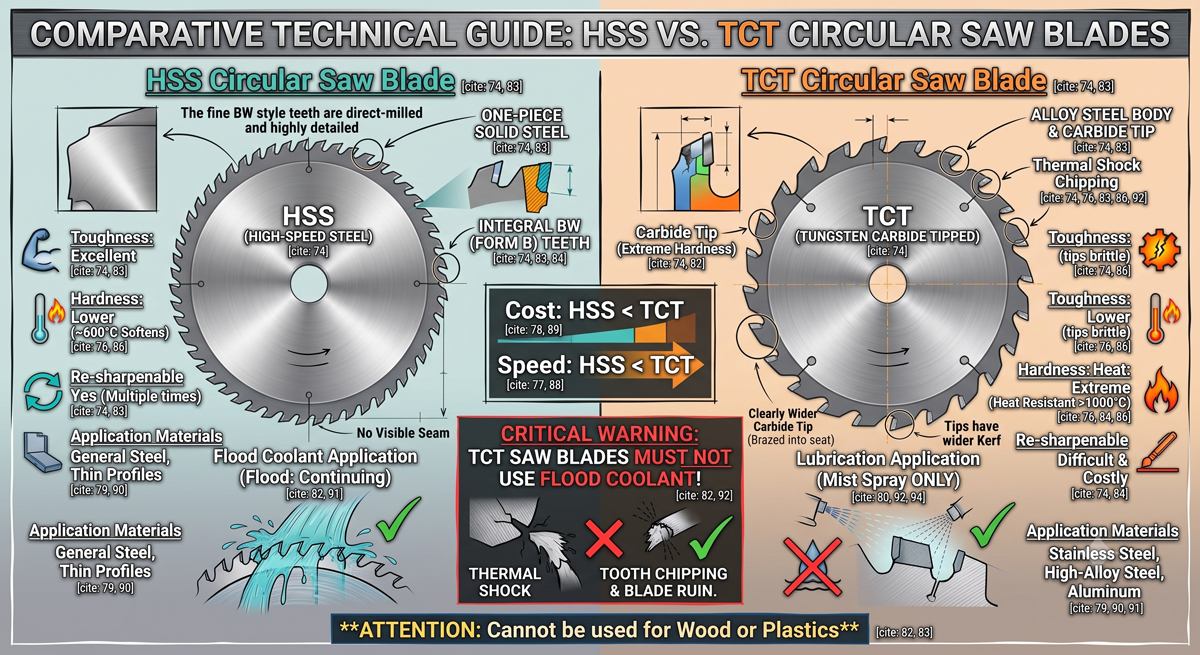
HSS blades are manufactured in one piece from a solid sheet of high-speed steel.
- Advantages: Extremely high toughness, able to withstand significant impact forces without shattering. It is relatively affordable, and the blade can be resharpened multiple times after wear, effectively extending the overall lifespan.
- Kentai's Strong Support (Saw Blade Sharpening Machine Series): Addressing the resharpening needs of HSS blades, Kentai, as the first professional manufacturer in Taiwan to develop HSS circular saw blade sharpening machines, provides a series of top-tier sharpening equipment. Whether it's the semi-automatic saw blade sharpening machine (e.g., SG-1 model), or the 2-to-4 axis CNC fully automatic sharpening machines (e.g., KNC-500CBN, KNC-710H series) equipped with color LCD touch interfaces and conversational input functions, users can easily achieve one-step, fully automatic precision grinding from tooth profile to chamfering in-house, making them the best tools for HSS blade mass production and maintenance.
- Disadvantages: Heat resistance and hardness are inferior to TCT; prone to losing hardness (annealing) due to high temperatures during high-speed cutting or when cutting high-hardness metals.
2. TCT (Tungsten Carbide Tipped)
The body of a TCT blade is usually made of alloy steel, but a piece of extremely hard tungsten carbide is welded to the tip of each saw tooth.
- Advantages: Possesses extremely high hardness and excellent high-temperature resistance. It can maintain sharpness for a long time, has a fast cutting speed, and produces smooth cuts with minimal burrs.
- Disadvantages: Tungsten carbide is highly hard but relatively brittle, making it prone to tooth breakage (chipping) upon strong impact; it has a higher unit price, and the cost and technical threshold for resharpening are higher.
Core Differences Comparison Table: HSS vs. TCT Blades
| Comparison Item | HSS Circular Saw Blade | TCT Circular Saw Blade |
|---|---|---|
| Hardness & Wear Resistance | Medium | Extremely High |
| High-Temperature Resistance | Lower (Softens at ~600°C) | Extremely High (Can withstand >1000°C) |
| Toughness & Impact Resistance | Excellent (Resistant to chipping) | Poorer (Brittle tips, prone to chipping) |
| Cutting Speed | Slower (For low-speed machines) | Faster (For high-speed machines) |
Different Metal Cutting Materials: Which Blade Suits Your Workpiece?
When choosing a blade, "What are you cutting?" is the primary question.
1. Mild Steel, General Iron Pipes, and Thin-walled Profiles:
Both HSS and TCT are acceptable. If the budget is limited and the machine speed is slower, HSS is fully capable. If pursuing ultimate production efficiency, using a TCT blade can significantly reduce processing time.
2. Stainless Steel and High-Hardness Alloy Steel:
TCT (or cobalt-containing HSS-Co) is recommended. Stainless steel is extremely prone to work hardening and generates extremely high temperatures. Standard HSS wears out rapidly; TCT blades specifically designed for stainless steel must be used to handle it.
3. Aluminum Alloy Profiles:
TCT is recommended. Cutting aluminum usually requires higher rotational speeds to ensure a smooth cut. TCT blades are highly speed-resistant and sharp, making them the preferred choice for aluminum extrusion processing.
Fatal Details: Strict Application of Coolant and Cutting Fluid
Cutting fluids and coolants play the roles of "cooling, lubricating, and chip removal" during the machining process, but there is an extremely strict and fatal difference in liquid selection for HSS and TCT.
HSS Blades: Broadly Supported, Highly Dependent on Cooling
Because HSS has poor heat resistance, the blade will soften and dull once the cutting zone temperature becomes too high.
- Application Method: HSS blades can use Coolant (water-based cooling fluid) or cutting fluid for cooling and lubrication. A massive, continuous flood supply must be maintained to effectively remove heat. Without the protection of a cooling medium, HSS blades are easily ruined.
TCT Blades: Water-based Coolants Strictly Prohibited, Exclusive Mist Spray Lubrication
The tungsten carbide tips of TCT are extremely heat-resistant, and the cutting mechanism can transfer most of the heat to the iron chips.
- Fatal Error Warning: TCT blades absolutely must not use cold Coolant! If cold coolant is sprayed under extremely high-temperature cutting conditions, it will trigger a drastic thermal expansion and contraction effect, directly causing the tungsten carbide tips to become brittle and chip (Thermal Shock).
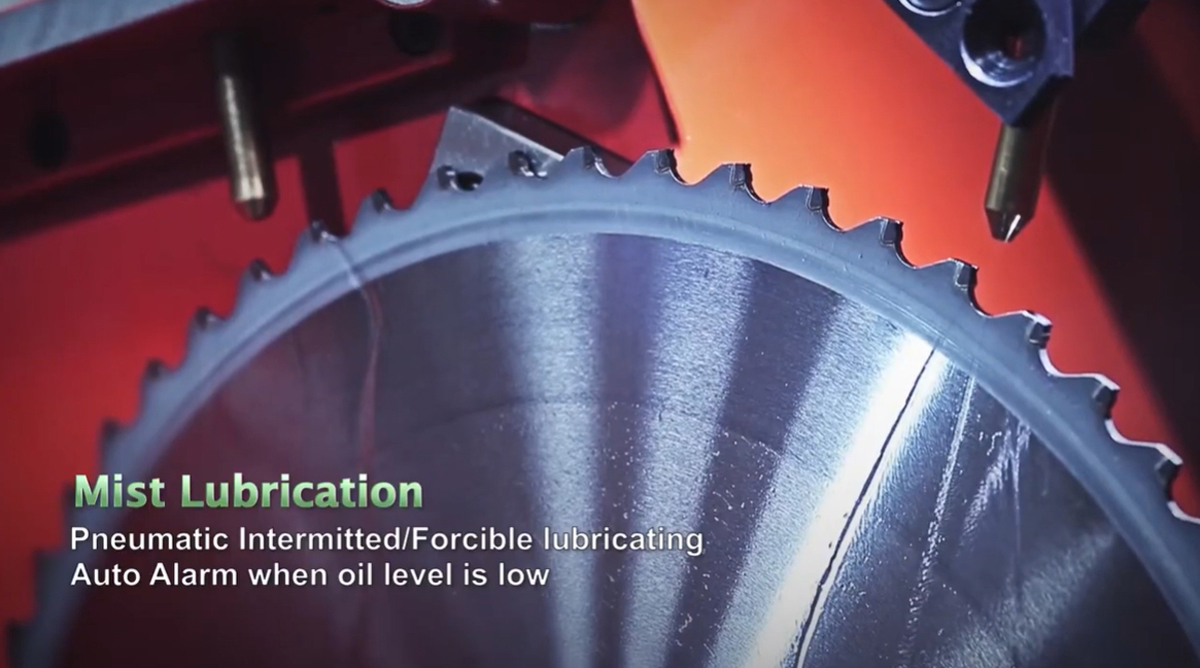
- Correct Application Method: Most circular saws paired with TCT blades adopt an extremely fine mist lubrication method. Simply spraying a minimal amount of oil mist can achieve perfect lubrication effects and ensure the safe operation of the blade.
Market Equipment Benchmark: Kentai Machine's Ultimate Compatibility and Mist Spray Technology
After understanding the blade characteristics and the strict limitations of cutting fluids, the system compatibility of the machine itself becomes crucial.
Kentai circular saw machines not only possess the aforementioned impeccable casting rigidity but also adopt the industry's advanced Mist Spray system, which can provide the most precise and delicate cutting fluid lubrication for TCT blades, perfectly avoiding the risk of tooth chipping and extending tool life.
Even more advantageous, Kentai machines are among the few top-tier machines on the market that are "simultaneously compatible with both Coolant and lubricating oil."
This means:
- When processing general mild steel using an HSS blade, you can turn on the Coolant system for massive cooling.
- When switching to high-end metal processing and changing to a TCT blade, you can directly use the machine's built-in Mist Spray system to spray lubricating oil.
This extremely high processing flexibility, coupled with the top-tier machine rigidity brought by FCD-45/FC25, makes Kentai machines and their full range of sharpening equipment the ultimate solution for metal processing factories to save tool costs and achieve automated production lines.
- How Kentai's Circular Sawing Machines Empower Automobile Industries
- High-Speed Circular Saw vs. Traditional Band Saw Machine: The Ultimate Showdown to Break Production Bottlenecks
- Metal Circular Saw Tube Cutting Guide: Key Differences in Cutting Steel, Stainless Steel, and Aluminum Tubes
- Which Industries Are Metal Circular Saws Suitable For? A Complete Guide to Key Applications